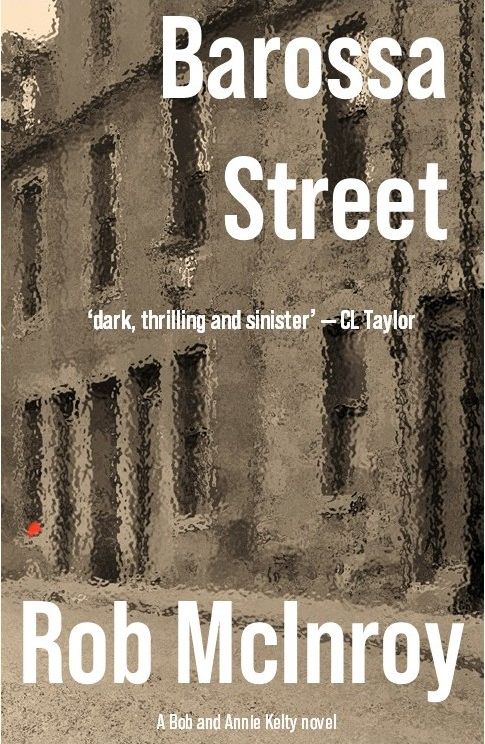
Barossa Street
20th January 1936, and King George V is dying.
The same day, Bob Kelty accompanies a friend to the house of a local recluse. There, they find Hugh Smithson brutally murdered.
Horror turns to nightmare as Bob's friend, Richard Hamill, comes under suspicion of the murder and Bob reluctantly becomes embroiled, once more, in the investigation of a terrible crime. Gradually, he begins to uncover the truth, and it is something nobody expected...
Set against the backdrop of the abdication crisis and the looming shadow of war, Barossa Street examines the prejudice of 1930s society and its impact on the justice system. Will this lead to the police jumping to conclusions and arresting the wrong man? Or will Bob save the day?
‘Hello?’ he shouted. ‘Mr Smithson, are you in?’
He went into a narrow hallway filled on either side by prints of mawkish Victorian art in cheap frames, angled haphazardly as though hung by a drunkard. At the far end he could see the front door. The key was in the lock. To his right was the living room he’d observed from Barossa Street. There were four empty bottles of McEwan’s 80/- lying on the floor, the Laughing Cavalier staring up at them. The ceiling was stained brown with nicotine. Next door, the room was a mirror image, cramped and untidy, smelling of staleness and still air and tobacco. It was empty.
He turned to the stairs and gripped the banister. ‘Hello?’ he shouted again as he began to climb the stairs. Fear pulsed in his throat and ears. Richard Hamill followed closely, barring any possibility of retreat.
‘Which one’s the bedroom?’ Bob said.
‘No idea. I’ve never been up here.’
Bob tried the first door. A box room. He tried the second door. A tiny bedroom, empty but for a wardrobe and a wooden chair. They retreated to the landing and he opened the third door, the door to Hugh Smithson’s bedroom.
They smelled it immediately, harsh and acrid, and both of them knew this was the smell of death. The room appeared empty, everything neatly in place except for the bed, where the bedclothes were rucked up as though someone had thrown them there in a hurry. And then Bob realised it wasn’t only bedclothes he was seeing.
There was something in the bed.
‘I think we’ve found Mr Smithson,’ he said. He eased the top blanket back. Beneath was a sheet and he removed that too, to reveal the upper body of Hugh Smithson.
‘Dear God,’ said Richard Hamill.
The Music of Barossa Street
Discover the music that helped to inspire scenes and episodes in Barossa Street and other works by Rob McInroy.
The Laughing Policeman
When some children get lost in a blizzard, Bob comes to the rescue. With a bit of a singalong...
The Runaway Train
The rescue continues...
Book Club Guide
How does Richard Hamill cope with the prejudice he experiences? Do you think he would experience the same prejudice if he lived in today’s Perth? What do you think of the way he was treated by the authorities?
The novel is set during the Edward VIII abdication crisis. Did you know much about that already? Do you think attitudes towards the Royal Family have changed?
At the start, Bob has resigned from the police. Why do you think he did that? Was he right to do so?
How has Bob changed since Cuddies Strip? What impact has Annie had on his life and career? How has Annie developed since Cuddies Strip?
How do you imagine Bob and Annie’s lives will pan out?
If you could spend a day with one character, who would it be? Why? How would you spend it?
Do you agree with the decision Bob makes at the end of the book? How else could it have played out? Would you have behaved differently?
Do you have a new perspective as a result of reading this book? Did you learn something you didn’t know before? Has your attitude or behaviour changed?
Book Clubs can obtain 20% discount on multiple copies of Barossa Street. Contact us here to arrange.
Barossa Street
Bob and Richard Hamill debate Richard's alibi and whether he dare use it...
Barossa Street
The mystery begins...